By Anila Yoganathan
Flatwater Free Press
This story is made possible through a partnership between Flatwater Free Press and Grist, a nonprofit environmental media organization.
Google’s Nebraska data centers consumed about 732 million gallons of water in 2025, the tech giant recently self-reported.
Viewed one way, that’s a lot of water: More than Omaha Metropolitan Utilities District customers use in an average week, combined, according to data from MUD.
Viewed another way: It’s less than you think. Google data centers consumed about as much water as it takes to irrigate between 2,500 to 3,500 acres of central Nebraska cornfields, according to Anthony Schutz, a University of Nebraska-Lincoln College of Law professor.
Nebraska irrigates about 9.1 million acres of agricultural land, UNL experts say.
“It remains a small amount relative to that,” Schutz said.
Water has emerged as a point of contention as companies could look to build more data centers in Nebraska, potentially adding to a current crop that already includes Google’s three data center locations in Omaha, Papillion and Lincoln, Meta’s Sarpy County data center and others.
Local residents and water professionals worry that new data center construction could use up water in certain parts of Nebraska, where water availability can vary widely and where wide swaths of this agricultural state are suffering through extreme drought.
Anticipating water issues, the data center industry is harnessing new technology and working to become more efficient with both its water and power usage. But the amount of water a data center uses can vary widely by company and location. New state legislation could soon force companies to disclose their annual water use and power demand.
“The majority industry across data centers and energy, I think my view is we’re doing the right thing, but is there a percentage of bad actors that are going to be that drunken sailor or pirate that doesn’t care? Yeah,” said Pete Marin, the CEO of T5 Data Centers, which owns, operates and develops data centers in the Midwest and across the country. “It’s unfortunate you can’t get 100%, right? Because somebody new to the game is going to say, ‘Wait a minute, I can come in and just take advantage here?’”
How data centers use water
On an April night, residents who live around Adams gathered for a special meeting to discuss the large tracts of nearby land that Omaha-based energy company Tenaska had recently optioned, potentially to build a natural gas plant and data center project.
Much of the meeting at the Adams Community Building focused on water.
The group of nearly 70 attendees wondered: How many center pivots running in southeast Nebraska equals the water usage of a data center? They debated the point, did math, tried to compute how much water might be sucked out of the ground if a new data center were built in Gage County.
Here’s a problem, though: The amount of water a data center uses can vary from little to millions of gallons per year, with companies taking various approaches, according to experts studying the industry.
And here’s another: The only way to know how much water or power that data centers guzzle is if the companies that own them are transparent. While some like Meta, Google and Amazon are, others, like xAI, are less transparent, said Jonathan Koomey, a researcher who has studied data centers since the 1990s.
Not all companies report water usage the same way. Meta self-reports water withdrawal, which translates to the total amount of water the data center takes in from the local water supply. From 2020 to 2024, Meta’s 4-million-square-foot Sarpy County data center withdrew anywhere from 26.7 million gallons to 37.5 million gallons, with the numbers varying each year.
For its Nebraska data centers, Google reports withdrawal and consumption, which shows how much water is used and not returned back to the local water supply. Google built its Papillion data center in 2019, an Omaha data center in 2022 and then announced the Lincoln project in 2023.
The company self-reported consuming 46.6 million gallons of water in Nebraska in 2022. But that figure spiked to 134.7 million gallons in 2023 and skyrocketed to about 732.1 million gallons in 2025. The company also has a data center just across the Nebraska border in Council Bluffs, Iowa, which the company self-reported consuming more water than any of its other data center locations in 2025 at 1.3 billion gallons. And companywide, Google expects its data center water consumption to grow.
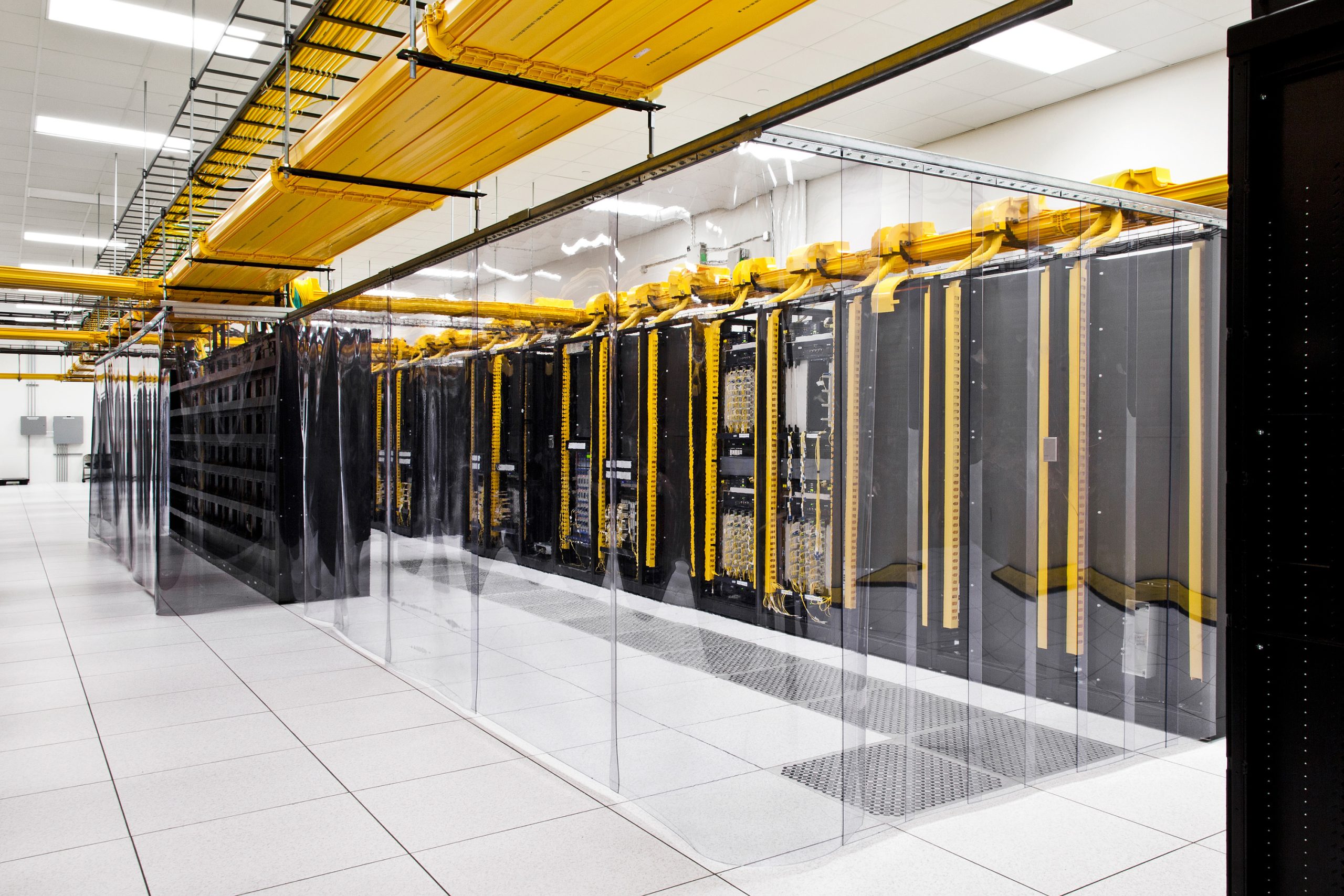
Data centers can use water to cool the building and the computer servers inside the building. Keeping everything cool ensures the equipment inside doesn’t malfunction.
These centers also use many methods and technologies for cooling, some of which are also used by large office buildings, airports and other industrial-scale facilities, Koomey said.
One example: Evaporative cooling systems, which typically use large amounts of water that evaporates into the atmosphere, Koomey said. Another is an air-cooled chiller system, which uses either water, coolant or a combination that can be recycled for years, through a “closed loop,” Marin said.
All T5 data centers built in the last 10 to 15 years use closed-loop systems. Some haven’t had to be flushed out and refilled with liquid since they began operations, Marin said.
Currently, evaporative cooling generally uses more water, while closed-loop cooling typically uses more electricity, creating a balancing act for data center companies and utilities.
“What’s best? It depends on the data center, its design, the local climate, if you have enough water, if you have enough power, what people want, what they’re willing to devote their resources to,” said Eric Masanet, a University of California, Santa Barbara engineering professor.
Depending on water availability, Google uses evaporative cooling or closed-loop, air-cooled chiller systems, Ben Townsend, the company’s head of infrastructure and sustainability, said in an email. The company assesses local watersheds before and after building.
Meta’s Sarpy County data center uses a combination of evaporative and closed-loop cooling.
To complicate the situation further, any coal, nuclear or natural gas plants supplying power to the data center could also use water.
In North Carolina, there has been talk of barring data center companies from using evaporative cooling. But Koomey argued to the Flatwater Free Press that this is a bad idea since technology is changing. A ban, he said, could actually lead to increased electricity use and more water consumption from that industry.
As the water worries continue, advances are being made that could soon allow data centers to use far less of it, said Dan Diorio, vice president of state policy at the Data Center Coalition.
“I think water use will go down, certainly,” he said. “I think the new technologies are going to be very water efficient.”
Nebraska water availability
Water availability isn’t created equal in Nebraska, with some areas of the state far more fortunate than others. Omaha’s water utility can supply about triple the amount of water it needs on an average day, pulling both from wells near the Platte River and surface water from the Missouri River. Meanwhile, Lincoln withdraws water from wells near the Platte River.
Groundwater supply is variable east of Seward County, while west of the county, there’s a lot more, according to Schutz.
- Water withdrawal from surface water like rivers and streams is primarily permitted by the state.
- Water withdrawal from groundwater is primarily permitted by Natural Resources Districts.
- Omaha’s Metropolitan Utilities District can supply about 320 million gallons of water per day, but demand averages about 98 million gallons a day.
- In its service territory, MUD currently has at least 10 data centers that are considered high-water-use customers.
- Lincoln can supply about 110 million gallons of water per day.
- Lincoln has one data center in its service territory.
- “In all areas of the state, we have a planning process in place, and the objective of that planning is again to protect all existing users in those given areas, and then we can kind of look at then beyond protection, what sort of opportunities are there for additional developments, and … we’re very fortunate to have a framework like that,” said Jesse Bradley, director of the state Department of Water, Energy, and Environment.
While data centers have typically located within urban areas, developments have moved farther out to suburbs and rural areas as fiber and infrastructure have improved, Diorio said. This raises concerns for water professionals in Nebraska who worry data centers might choose an area that either doesn’t have enough water already or whose water supply is already fully allocated.
That’s especially concerning since about 99% of water consumption in the state comes from irrigation. With water use expected to rise due to droughts and higher temperatures from climate change, water policy and allocation is top of mind, said Crystal Powers, water extension educator at the University of Nebraska-Lincoln.
“From a logical, common-sense perspective, we really need to stop putting industry in areas where they can’t be supported” by natural resources like water, said John Winkler, general manager of the Papio-Missouri River Natural Resources District. “… It doesn’t make sense to put a data center in an area that’s very water insecure to begin with.”
Kyle Hauschild, general manager of the Nemaha NRD, said he has received an outpouring of questions and concerns from Adams-area residents about where the potential Tenaska project could go. He said there might not be enough water to supply a potential data center and gas plant underneath the area where Tenaska optioned land in Gage County.
Both Hauschild and Winkler said their NRDs are updating regulations to account for future water use.
Some swaths of Nebraska have available water, while in other parts of the state, both surface and groundwater are fully allocated, Powers said.
For groundwater, this means that for a new user to come online, an older one will first have to stop using water. Additionally, surface water primarily hinges on annual precipitation, and its supply varies more than groundwater, said John Hay, an energy extension educator at UNL.
Water professionals in Nebraska are still getting their heads around what new data center developments could mean for their jurisdictions. Hay said energy and water professionals would “feel a lot better” if they could know how a new data center plans to use water, where that water will be going, total annual use and maximum daily use.
The Nebraska Department of Water, Energy, and Environment will begin to collect information like annual water use and energy demand later this year, following a new state law requiring this passed by the Nebraska Legislature during its 2026 session.
Bradley said the state agency will then see what it receives and what information holes remain. He said the legislation is a “great start” and will help for future planning.
Data center researchers Eric Masanet and Jonathan Koomey said the pressure being put on this industry to be more efficient and transparent is a good thing.
“I work with a lot of people in the tech industry, they’re pouring trillions into this industry, like we should hold them to account and make them install the very best technologies that minimize energy and water,” Masanet said. “They should be a lot more transparent. We should demand it, because you know they’re …(investing) tons of money … If anyone could do it, it’s this sector.”
The Flatwater Free Press is Nebraska’s first independent, nonprofit newsroom focused on investigations and feature stories that matter.