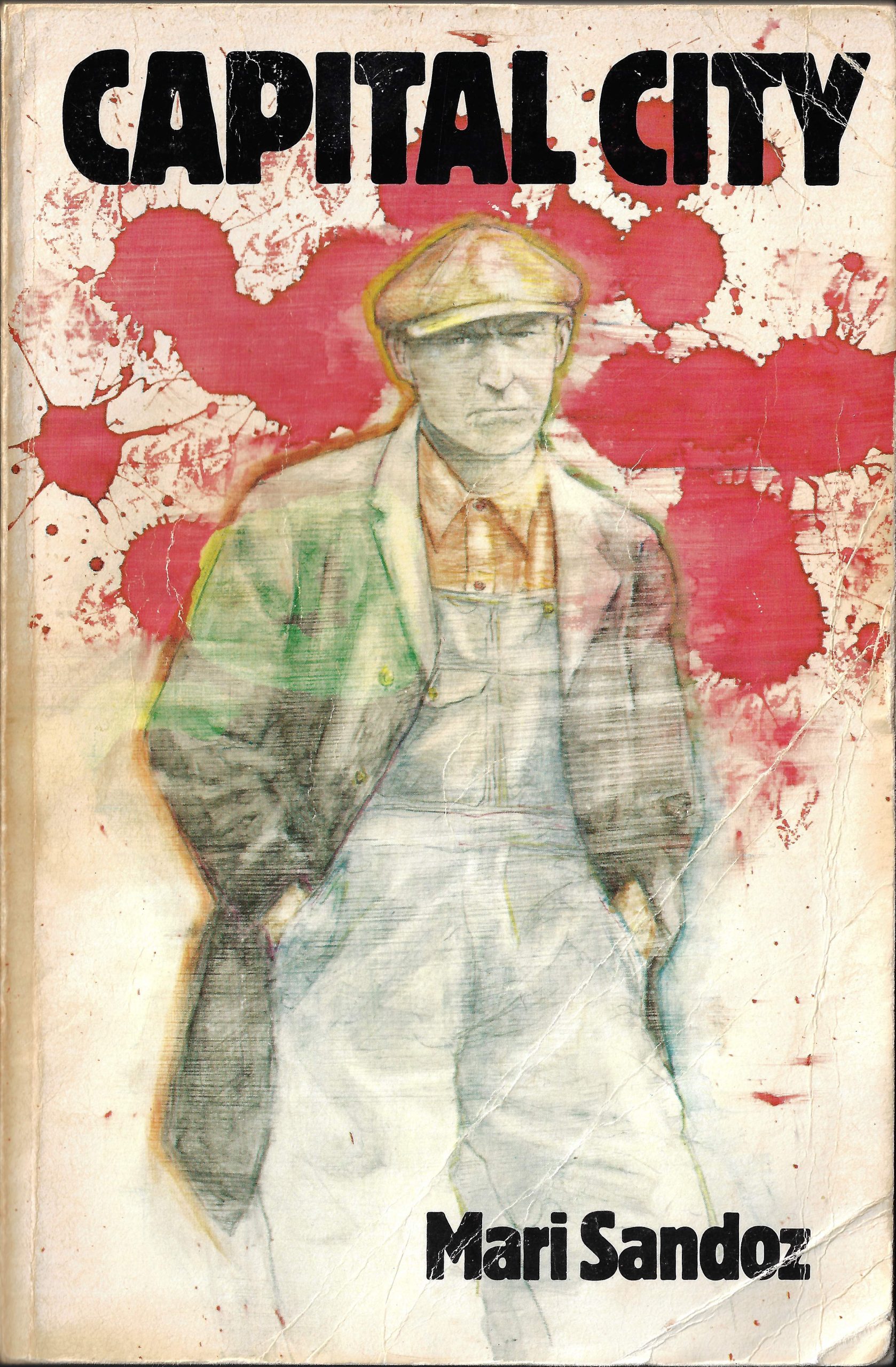
(Pictured: “Capital City,” the second novel by Nebraska native Mari Sandoz, did not win her any fans in Lincoln. Many people believed the fictional city depicted in her story was based on Nebraska’s capital city. Photo by Tynan Stewart for the Flatwater Free Press)
A novel got its author run out of Lincoln. Nearly a century later, the city is giving the story a second chance.
A new theatrical adaptation of Mari Sandoz’s “Capital City” is set to premiere at the Lied Center in Lincoln.
By Tynan Stewart, Flatwater Free Press
It was the summer of 1940, and Mari Sandoz was done with Lincoln.
The Nebraska-born author, who had lived in the capital off and on since 1919, denied her upcoming move to Denver meant she was “running away,” telling the Omaha World-Herald she was relocating to research her next book. But Sandoz also admitted that, yes, she had been getting angry phone calls for months. She had been hissed at and spit on in public. Someone had even slipped a threatening note under her door. She later described the contents to a reporter: “‘Better lay low. You’re the next candidate for a concentration camp.’”
The harassment started shortly after the publication of Sandoz’s second novel, “Capital City,” in 1939. The book, which satirized the politics and society of a fictional Midwestern college town that closely resembled Lincoln, sold poorly but aroused the ire of her neighbors with its scathing depiction of a citizenry sympathetic to fascist movements in Europe.
“Sandoz was essentially run out of town for writing this book,” said Karim Muasher, an actor and theater director.
While Sandoz never moved back to Lincoln, her novel will soon have a second shot in the Star City thanks to Muasher and his co-artistic director, Carrie Brown. Their New York-based theater company, Animal Engine, is producing a stage adaptation of “Capital City” that will premiere at the Lied Center on April 9. Muasher and Brown, along with their occasional collaborator Jay Dunn, wrote the script, designed the set and will also star in the production.
The Lied approached Animal Engine a few years ago to commission a Nebraska-focused work. Sandoz, as a historically significant Nebraska author, was a clear choice, and eventually they settled on “Capital City.”
“We were just completely taken by how relevant and modern the book felt,” Muasher said. “It really felt like it was written in the current day.”
After premiering in Lincoln, Animal Engine’s production of “Capital City” will also visit Fremont, Falls City and Auburn as part of the Lied Center’s Arts Across Nebraska program, which aims to increase access to the performing arts in the state’s rural areas. The center is also working with the Lancaster County Youth Services Center to stream a performance for incarcerated kids and to organize an in-person Q&A with the artists.
INFO BOX: Upcoming performances
April 9-12 – Lied Center, Lincoln
April 14 – Fremont Opera House, Fremont
April 16 – Prichard Auditorium, Falls City; 7:00 PM
April 17 – Auburn Public Schools Central Office Auditorium, Auburn
More information at www.liedcenter.org/education/arts-across-nebraska
Jane Schiermeyer Hansen, director of education and community engagement at the Lied Center, said the performing arts center tries to prioritize works with a connection to Nebraska whenever it can.
“I think Nebraskans are really interested in Nebraska stories,” she said.
Is ‘Capital City’ really about Lincoln?
Technically, the novel that ruined Sandoz’s reputation in Lincoln isn’t set in Lincoln — or even Nebraska, for that matter.
The story actually takes place in Franklin, a fictional city in the imaginary state of Kanewa, a portmanteau of Kansas-Nebraska-Iowa. Sandoz, who was known for conducting intensive research for her books, studied multiple state capitals in the Midwest, including Des Moines, Topeka and Jefferson City. Her fictional capital also has aspects seemingly borrowed from Omaha, such as an annual coronation of upper-class socialites as “the emperor and empress of the land of Kanewa” — possibly modeled on a similar ceremony organized by the Knights of Ak-Sar-Ben.
“She had no one capital city in mind, but wanted to reveal what she saw as a trend in the capital cities of the Middle West, towns that produced little, that had little commerce, but lived off the state capitol and the adjacent university — parasites, just as Washington, D.C., seemed to her the archparasite,” wrote Helen Winter Stauffer, a longtime University of Nebraska at Kearney professor, in her biography of Sandoz, “Mari Sandoz: Story Catcher of the Plains.”
https://www.youtube.com/watch?v=msNHusaDuAE
Despite Sandoz’s repeated assertions that “Capital City” was allegorical and not modeled on any single location, some Lincolnites didn’t believe her. A 1939 review in the Nebraska State Journal observed that the book contained “many men and women who will be recognized, rightly or wrongly, by many readers.” It also didn’t help that Sandoz borrowed one of Lincoln’s most distinctive landmarks — a capitol building with a “high white tower.”
Brown, who grew up in Lincoln and studied theater at the University of Nebraska-Lincoln, said she immediately recognized the setting.
“When I read it, there was, like, no doubt in my mind,” Brown said. “This is not an amalgamation. This is just Lincoln. There’s nothing about the city that isn’t Lincoln.”
‘Rhyming with the present day’
Although the backlash to “Capital City” was ugly and excessive, it’s not hard to see why some residents resented Sandoz. It wasn’t just the novel. As she was planning her move to Denver, Sandoz told a reporter: “I don’t like Lincoln, and that is no secret. But I didn’t like it 20 years ago.”
Sandoz was also an unapologetic liberal, sympathetic to the labor movement and the poor, while Lincoln was at the time decidedly conservative. (Lancaster was one of only two counties in Nebraska that voted for Republican Herbert Hoover in the 1932 presidential election.) “Capital City” is a harsh portrayal of both local and state politics and ends with the election of a demagogic far-right governor who declares martial law and deploys the National Guard, though most of the populace is too preoccupied with a college football game to notice or care.
Lincoln’s political leanings have shifted in the decades since, if not its obsession with football. But many of the novel’s themes still feel timely.
“We were really excited by the historical time period and by the parallels that we can find between the late ‘30s and now,” Muasher said. “They say that history doesn’t repeat itself, but it rhymes, and this book is definitely rhyming with the present day.”
Muasher said the story’s association with Lincoln is ultimately a positive thing for local audiences, and he hopes people who have read “Capital City” will come out to see the play.
“What you’re gonna see on stage is actually inspired in part by the place that you live in,” Muasher said. “The fact that it’s a historical piece I think is gonna dull some of the hurt feelings.”
A return to the Lied Center
This won’t be Animal Engine’s first time performing in Lincoln.
In 2023, the theater company brought its original play “Henrietta Solway,” which is based on the fiction of Willa Cather, to the Lied Center, kicking off the relationship that would lead to their current collaboration. Before that, Muasher and Brown visited the city for a high school tour with their show “Petunia and Chicken,” another adaptation of Cather’s work.
“I got to go back to Northeast (High School) and perform for my drama teacher, which was really cool,” Brown said.
Performing at the Lied Center is particularly special for Brown. Her family first moved to Lincoln in 1993 when she was 10, and she remembers the performing arts center as a formative part of her childhood. At the time, it was still relatively new, having opened in 1990.
“We had some family friends that lived in Lincoln, and the Lied Center was one of the first places that they pointed out to us,” she said. “In some ways, performing at the Lied Center is just as cool for me as opening up on Broadway.”
Last summer, Animal Engine visited Lincoln for a few weeks to work on the production of “Capital City,” and Brown found herself pointing out familiar places to Muasher and Dunn.
“If I hadn’t grown up in Lincoln, I don’t think I would have seen so much in the book as I did,” Brown said.
The Flatwater Free Press is Nebraska’s first independent, nonprofit newsroom focused on investigations and feature stories that matter.