The Beatrice High Class of 1961 recently gathered to celebrate its 65th class reunion and watch a documentary on their 15-year reunion. It remains a “hidden gem” of cinema, says the manager of a Lincoln theater that will screen the film this month.
By Leo Adam Biga
Flatwater Free Press
When about two dozen members of Beatrice High’s Class of 1961 recently gathered for their 65th reunion, it was more than the usual redux. For many, it marked the first time in years that they had set their eyes on a cinematic time capsule — a feature-length documentary chronicling their 15-year class reunion that coincided with the U.S. bicentennial 50 years ago.
“Reunion ’61-’76” was made for and broadcast on Nebraska Educational Telecommunications (now Nebraska Public Media) then largely vanished, save for a few screenings at class reunions over the decades.
“I think it holds up very well,” said grad and retired history professor Bob Cherny, who co-moderated a Q&A at the July 11 reunion in Beatrice.
A sharper, digitized version of the film will debut July 29 as part of the Made in Nebraska series at the Mary Riepma Ross Media Arts Center in Lincoln. Ross program manager Laurie Richards called the film “a hidden gem of the cinema verite movement that should be seen because it reflects its times in such a raw, remarkable way.”
Its maker, John Spence, was himself a member of the Beatrice Class of ’61, and in 1976, he worked in NET’s film unit. He said the concept behind the project was simple.
“Because we literally hadn’t gotten together as a group for 15 years, and a lot had happened in the meantime. I was frankly very curious to see how people turned out and if they had found a unique way of getting by.”
Spence had no script, just an idea that evolved as he met with people and events happened. Of course, he needed buy-in from his classmates. They agreed to participate “because we knew film was John’s thing so we just sort of went along with it,” said classmate Pete Genzlinger.
“I’m not sure many people thought anybody would see it anyway besides us,” he added.
LINK TO DOC: https://www.youtube.com/watch?v=ZrLnXGODMzM
The group proved willing participants — and worthy subjects.
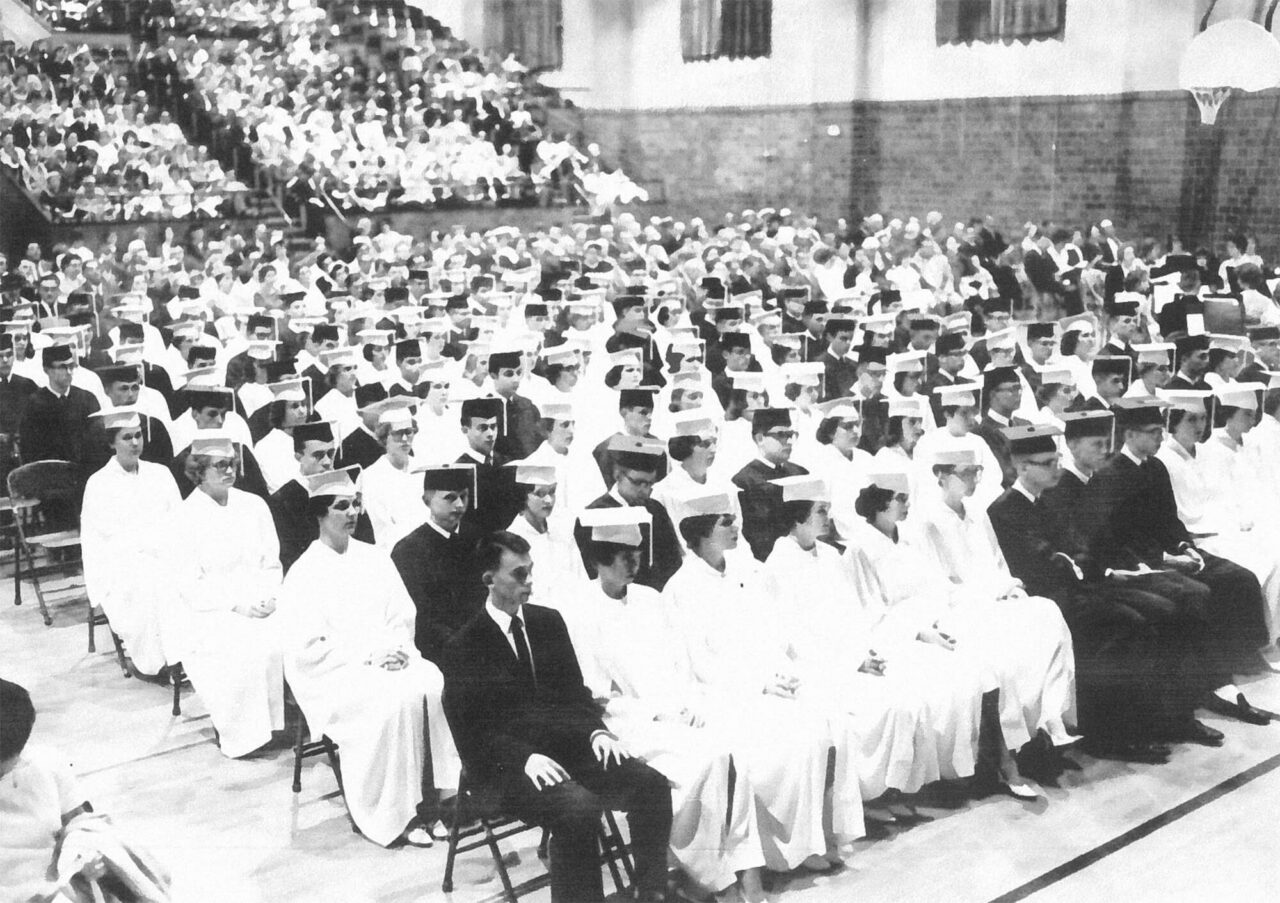
When they entered the world, World War II was still raging. Both Spence’s and Cherny’s fathers died in the conflict. When the 135 graduates received their diplomas at the municipal auditorium on May 24, 1961, John F. Kennedy was still president. The Cuban Missile Crisis had not happened. Vietnam was far from most Americans’ radar. The Beatles were years away from invading the U.S.
After their graduation, the country saw change and tragedy: the sexual revolution and rise of feminism, the fight for civil rights, Cold War dread, the assassinations of JFK, Malcolm X, Martin Luther King Jr. and Bobby Kennedy, the Vietnam War, Watergate.
By the time this cohort reunited in the bicentennial year, they were veterans of the nation’s culture wars, witnesses to a decade and a half of upheaval not unlike today’s America.
In the film, grads share what they did after high school — from serving in the military to attending college to entering professions to starting families. Some moved away, some stayed put. Some did what they set out to do, others were still searching.
A surprising number found themselves in creative careers. Genzlinger painted and taught art. Vicki Krecek became a writer and Omaha communications professional. Jim Meyers ran his own photography studios and a pottery business. Barbara Hibben became the first research assistant for the then new Sheldon Memorial Art Gallery before heading to the East Coast. Gibb Hedges became an illustrator and ran the popular Beatrice bar Gibbs’ Place for three decades.
And there was Spence, the filmmaker. As he came of age, his ambivalence about his hometown grew. By the time graduation came, he couldn’t wait to get away. But he didn’t get far — he has lived in Lincoln since 1962.
“Quite frankly, the more and the further I went away, the better home looked. … Lincoln’s only about 40 miles from Beatrice, but in my heart, my mind, it’s a thousand miles away.”
The 65th reunion was a different experience for this group of now 82- to 84-year-olds reflecting on themselves from a half century ago. Whereas with earlier reunions people talked about careers and families, the focus now veers toward the bigger picture.
“The list of people that have died gets longer every year, and it’s so sad,” Krecek said.
Hibben, who became a career U.S. foreign service officer after her art career, traveled from Pennsylvania with a daughter for the 65th reunion out of a sense of urgency. “Because I think it’s probably going to be the last time I get to see some of these people,” she said. “I miss quite a few who I remember well.”
Meyers, who recently resettled in Beatrice, acknowledged the reality of their age. But he mused, “There’s a pretty good group of us that feel like we’re just going to keep going. Maybe we’ll have a 75th. Why not? If you don’t believe that way then you probably won’t make it.”
Watching the film again, some noted how the polarization of today reminds them of the divisions of the turbulent ’60s and ’70s.
“Yeah, I thought about that when I watched it,” Krecek said.
The Class of ’61 has managed to avoid that same division at their reunions, going to lengths to avoid talking politics and other polarizing subjects.
“We recognize that at meals people may end up at separate tables because they may feel strongly on both sides,” Hibben said.
The doc doesn’t refer to the disproportionate number from the class who pursued creative lives or careers, but 65th participants did. Past reunions featured exhibitions of classmates’ work. Grads pointed to the town’s maverick streak and legacy of strong art teachers — like Don Hazelrigg, who Meyers said encouraged students to “explore” and make things — as contributing factors.
Spence said “Reunion ’61-’76” is his answer to “nonfiction unfettered personal filmmaking.” Michael Farrell was the director of photography on the project and used a handheld camera to capture its intimate black-and-white images. He feels Spence made a minor classic.
“This is a very interesting slice of American life, and I think John’s got something really important to say with this film. It’s a really important piece of work and it shouldn’t just get buried someplace.”
Classmates appreciate that their class is the rare one anywhere, anytime immortalized in a film. Class archivist Peg Quakenbush echoed others in saying, “It’s very special … for us and we’re lucky.”
Meyers was teaching art in Nelson, Nebraska, when the documentary aired. His students watched it. Years later, one of those students told him that Meyers and his classmates inspired them to stick together much the same way. ”It wasn’t me,” Meyers said, deferring the credit, “it was John (Spence) and what he did with that (film).”
Spence is satisfied it remains an honest, unadorned looking glass into the past. “I do like the idea it could be about any small Midwestern town and the folks in it,” he said. “That’s the value of it in my mind.”
The ’61 class has gathered for past milestone reunions. When the 60th coincided with COVID, the reunion was held virtually. The 65th was not the first time the doc got screened. Seeing and hearing themselves from a half century ago elicited the usual laughs and perhaps more tears than past screenings.
Though Bob Cherny lives on the West Coast, he has actively organized several reunions. Why? “I guess just the idea to get back in touch with people I knew and fell out of touch with.”
Genzlinger, who has made all the reunions, said the attraction to catch up is natural.
“The first ones I attended, I was curious to see how people had changed. Some of those people I don’t know why I didn’t become closer to them in school because I realized they’re neat people and I wish I had. I wish I knew their story. Everybody has a story.”
The Flatwater Free Press is Nebraska’s first independent, nonprofit newsroom focused on investigations and feature stories that matter.