By JJ Harder
Flatwater Free Press
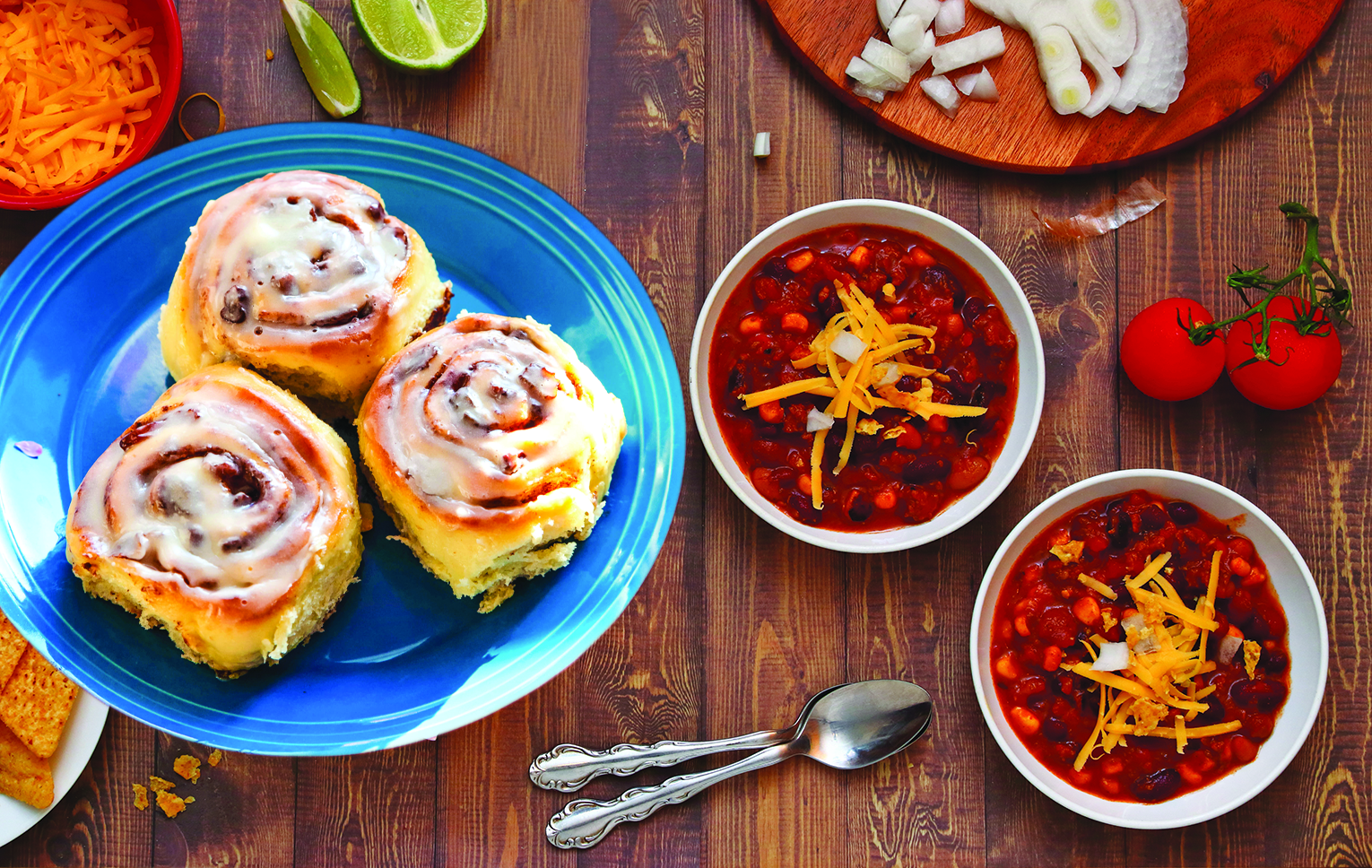
Kati Stauffer’s family moved in the 1990s from eastern Iowa to Lincoln to open a restaurant serving honest Midwestern cooking. Hot beef sandwiches. Pork tenderloin. Rhubarb pie. But they quickly realized they needed to offer two seemingly unrelated items as a combo.
“Someone gets in the mood for it and they come in for it,” she said. “They say, ‘I just had to have chili and cinnamon rolls today — please tell me you still have rolls left!’”
The pairing is still a fixture on the Stauffer’s Café menu, but it’s much more than just a diner thing — you’ll find it in school cafeterias, at high-end Omaha restaurants and at Husker tailgates. The unofficial season tracks almost perfectly with the non-daylight saving time months — from the first heavy coat for a football game to when the last of the blackened snow is melting in the Walmart parking lot.
In the social media age, regional foods have traveled far from their borders. Today, all over the world you can find Oklahoma smashburgers, NOLA gumbo, San Francisco Mission-style burritos and L.A. french dips. There is Nashville hot chicken in Saudi Arabia, Maine lobster rolls in Paris and Detroit pizza in China.
So why hasn’t Nebraska’s famous dish gotten in on this action and made it to the coasts or beyond? Why aren’t there viral videos about hot NYC spots with blocks-long lines of 20-somethings waiting to get their hands on Nebraska chili and cinnamon rolls?
For a dish that has barely made it out of Nebraska, the pairing of chili and cinnamon rolls exists thanks to surprisingly globe-spanning ancestry. Ancient Mesoamericans cultivated the predecessors of every chile pepper in the world today; ethnographer/priest Bernardino de Sahagún first documented the Mexica’s chile stews with frogs, worms or axoltls. Cattle that other 16th century Spaniards introduced to what they had renamed Nueva España led to chile con carne, “a popular Mexican dish — literally red peppers and meat,” first referenced in print in 1857.
Separately, the spice trade took cinnamon from Sri Lanka to the Roman Empire. The first recipes for cinnamon buns or “snails” appeared in 1500s Germany; immigrants brought the tradition to the U.S. two centuries later.
The first printed reference to chili and cinnamon rolls is from Indiana in 1905. The first school menu pairing chili and cinnamon rolls was in California in 1953. But these were likely random occurrences, says food historian Darcy Maulsby. “There’s no definitive answer to who was the first person or organization to serve the chili and cinnamon rolls combo,” she said. She suspects enterprising mid-century school cafeteria cooks deserve the credit.
In 1946, Congress passed the National School Lunch Act, and the USDA included chili in its “School Recipes for 100.” Greeley, Colorado, schools were the first to regularly serve the combo.
The pairing became common across Nebraska in the 1950s. The chili and cinnamon rolls recipe at Omaha’s now-defunct Garden Cafe was from the owner’s lunch lady aunt. Author Marion Cronan paired chili and cinnamon rolls in her 1962 school cafeteria handbook. An alternative theory posits that loggers sparked the trend by pouring chili over cinnamon rolls for breakfast before a hard day of tree felling.
Although the combo’s precise origin is lost to time, Nebraska is the dish’s holy land, its ground zero.
Nebraskans have a fervent pride over their dish. “Pairing them together, I think you get that bold, Tex-Mex taste of chili and then all of the sudden you get the sweet taste of a cinnamon roll,” said Mike Honerman, a member of the team that won the last two annual North Platte chili cookoffs.
The combo remains a lunchroom staple at schools across the state. The Lincoln Public Schools serves it on winter Tuesdays; LPS Nutrition Director Andrew Ashelford says they dish out 5,000-6,000 servings per day.
People who move to Nebraska consistently convert to the C&CR tribe. Amanda Trost, who came from Indiana for college and stayed, is a true believer. “My core memory of chili and cinnamon rolls stems from the first Halloween I spent in small-town Nebraska having a family soup supper before trick-or-treating,” she told me. “Since then, I’ve never served it any other way.”
But we must acknowledge that at least two neighboring states also claim the chili and cinnamon roll as their own. The Des Moines Register implied a small-town lunch lady in Iowa created it. The dish is the Kansas subreddit’s official meal. Top it with melted cheese and some call it “Kansas Crème Brûlée.” Wichita’s baseball team temporarily adopted the Chili Bun as its mascot.
I spent a week messaging every person who commented positively on any Facebook or Instagram post referencing chili and cinnamon rolls; the footprint looks suspiciously like the Oregon Trail, although many Pacific Northwest school districts have since stopped serving C&CR. Richland, Washington, School District’s Dawn Trumbull says due to USDA regulations requiring 50% whole wheat dough and a “downswing in home-style meals,” she now offers it to students once every five weeks in the fall and winter.
When Nebraskans go online or out of state and discuss the chili-and-cinnamon roll pairing with the uninitiated, the believers instinctively know how to sell the combo: It works because the hearty, salty and spicy mesh perfectly with the sweet, creamy and squishy. But there’s actually deeper science backing this up: The roll’s sugar and butter cool the burn of the chili’s capsaicin, while the chili’s salt and spice amplify the cinnamon’s perfume, according to Nik Sharma, America’s Test Kitchen editor-in-residence.
“Both dishes share aromatic molecules … which create an underlying bridge of warm, woody notes,” he told me. “The chili’s fat-soluble flavor compounds dissolve into the butter of the roll, tying everything together. It’s the same molecular logic behind mole poblano or spiced chocolate — heat meets sweet, and both taste bigger.”
The tentacles of Nebraska C&CR are beginning to spread. Now there are chili and cinnamon roll burgers, patty melts, bierocks, pizza, handpies, ice cream and popcorn. There’s a chili cinnamon roll, a cinnamon roll bowl with chili in it, and a C&CR to celebrate Yom Kippur. The Chilibon has been an off-menu combo at Wendy’s restaurants nationwide since last year.
Yours truly even once C&CR’ed a Bunny Chow, a classic South African dish that itself is a mashup of Indian and Afrikaner traditions.
Nebraska-based fast-food chain Runza has done its part to take the tradition further afield. Since 2007, it has offered C&CR at all its restaurants, which are also in Colorado, Iowa, Kansas and South Dakota.
The combo actually sells the best in Scottsbluff/Gering, Runza spokesperson Becky Perrett told me.
Cornhusker football coach Matt Rhule called it “life-changing.” Nebraska native and Minnesota Gov. Tim Walz has proselytized for it. The closest C&CR made it to going viral was when celebrity chef Alton Brown tried it.
State leaders recognize the potential in using C&CR to expand the Nebraska brand. The Nebraska Beef Council’s Adam Wegner called it “exactly the kind of hidden gem food trend that can catch national attention.”
“People love a dish with a backstory,” he said. “That’s one of the major appeals to chili and cinnamon rolls. Whether it’s served at school cafeterias or a community supper, it’s comforting, practical and 100% heartland.”
Visit Nebraska’s Jenn Gjerde said she has highlighted it in online content because it’s like Nebraskans themselves: “Warm, welcoming and a little unexpected … When something like this takes off online, it creates buzz you can’t buy.”
One obstacle to the chili and cinnamon roll combo becoming nationally recognized is confusion around how to eat it. I see seven categories of C&CR eaters:
* The Rip-and-Dippers scoop the chili with part of the roll they’ve pulled off.
* The Fonduers break off smaller pieces of roll, stab a fork into one and dip the forked roll into the chili.
* The Croutoners tear up the roll into bite-sized pieces and mix them into the chili.
* The Alternators bounce back and forth between spoonfuls of chili and bites of roll.
* The Pour-Overs place a whole roll into a bowl they then fill with chili.
* The Dinner-Then-Desserters consume all their chili before moving on to the roll.
* Finally, the Bowl Cleaners eat most of the chili first but then wipe whatever is left with pieces of roll.
In the Dinner-Then-Dessert camp is Dallas resident Ryan Busboom, who remembers eating the combo “about once a month” at Malcolm High School. “Once I started on the roll, I was done with the chili,” he told me.
Brian Kurbis, who grew up in Omaha but now lives in Thailand, agreed: “The standard sequence of savory meal before sweet dessert was respected.”
Some Nebraskans steadfastly regard dipping as an unpardonable heresy. Self-described “naturalized Nebraskan” Ryan Boyer says in York, “Most people I know eat a few bites of chili before taking a bite or two of the cinnamon roll.” Jeremy Hosbein grew up in Bellevue and Papillion “breaking the cinnamon roll into pieces and then throwing it in the chili.” Committed dipper Vanessa Romano, who grew up in Omaha, says the key is a chili with a “thicker consistency so the cinnamon roll bite doesn’t get too soggy.” Suzy Ernest remembers dipping as a child in Sidney: “Sometimes, you’d put a large part of the roll in to get soaked (if) there was enough liquid.”
Another problem is that when people merely first hear about C&CR, they are disgusted. “It came from those Midwest heathens,” “Nope — straight to jail” and “What kind of savage does this” are printable Reddit reactions. East Coast chili and cinnamon roll bigwigs are skeptical of our flyover ways. Chef Armando Litiatco of NYC “cinnamon roll empire” Sunday Morning had never heard of the pairing. “My initial reaction … That’s odd. But the savory, salty and sweet could be nice. But that’s odd. But the cinnamon against the chili, maybe. But that’s odd.”
Vida Ali’s iconic D.C. restaurant Ben’s Chili Bowl serves four types of chili on dogs, burgers or nachos or in a bowl “with some crackers or cornbread.” With a cinnamon roll? “Hmmm. Only in Nebraska! But somehow, I’m intrigued,” she told me.
Many Nebraskans realize they are outliers in eating chili with cinnamon rolls. “It’s something that other people hear of and think, ‘That’s weird,’” said Kati Stauffer. “It’s tough for us to have a place of pride when it comes to food. This is kind of our food identity.”
The Flatwater Free Press is Nebraska’s first independent, nonprofit newsroom focused on investigations and feature stories that matter.